Why choose vidaXL?

24/7 deals
Find the best deals & discounted products every day at vidaXL!

Free shipping over £ 70
Enjoy free shipping on all orders above £ 70.

Get discounts with vidaXL+
Opt in with your account today and watch your vidaXL+ points grow. The more you shop, the bigger the discounts you can unlock!




















.png?sw=192)

.png?sw=192)
.png?sw=192)
.png?sw=192)

.png?sw=192)
.png?sw=192)


.png?sw=192)

.png?sw=192)
.png?sw=192)
.png?sw=192)


Japandi: How a clutter-free home calms your mind
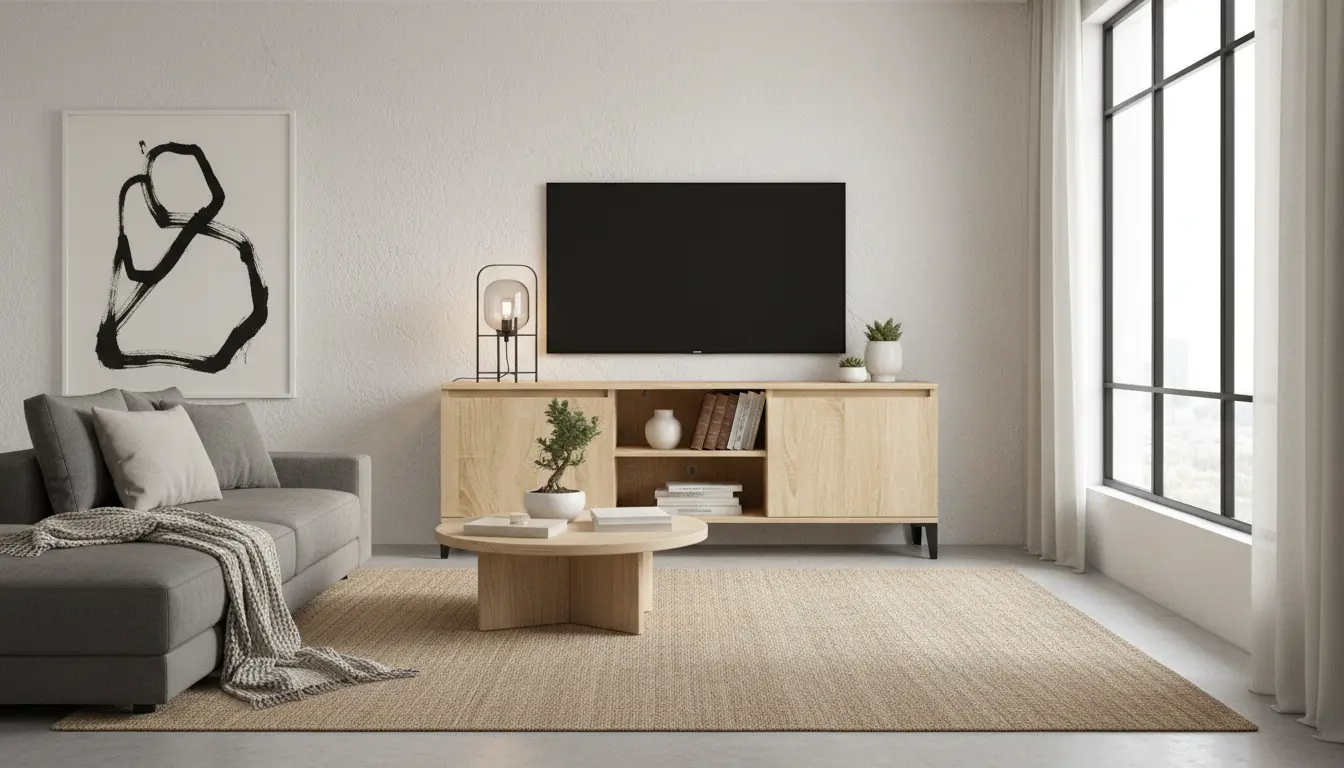
Is clutter stressing you out? The simplistic style of Japandi might just be the cure. Blending the tranquillity of Japanese style with the cosy functionality of Scandinavian living, it offers a home that's both organised and soothing.
In this text, we'll explore how Japandi's clutter-free approach can enhance your sense of well-being. From mindful decluttering and natural materials to timeless design and a touch of greenery, you'll learn how to bring Japandi's soothing balance into your own home in a way that feels authentic and uniquely yours. Ready to be inspired? Let's dive in!
How Japandi design can boost mental well-being
Japandi's popularity across the world reflects a collective desire for calm and balance in an increasingly hectic age. Its appeal lies not only in its visual harmony but also in the lifestyle it represents. In a world filled with noise, speed, and constant stimulation, the serene simplicity of Japandi offers a refuge – a place where the mind can rest and the senses can breathe.
Research indicates that home clutter correlates negatively with psychological well-being. Maintaining an organised and tidy living space can contribute to better mental health outcomes (Quinn 2025), and perhaps for this reason, many are drawn to Japandi because it offers a sense of control and clarity in contrast to the chaos of modern life. The neutral colour palette, natural textures, and minimal furnishings form a soothing backdrop. A clean canvas to return to after long, demanding days.
At its core, Japandi is about intentional living and choosing simplicity over excess, authenticity over trend, and comfort over clutter. Its global allure stems from this promise: a home that feels peaceful, functional, and beautiful, no matter where in the world you are.
Japandi style experiences a boom
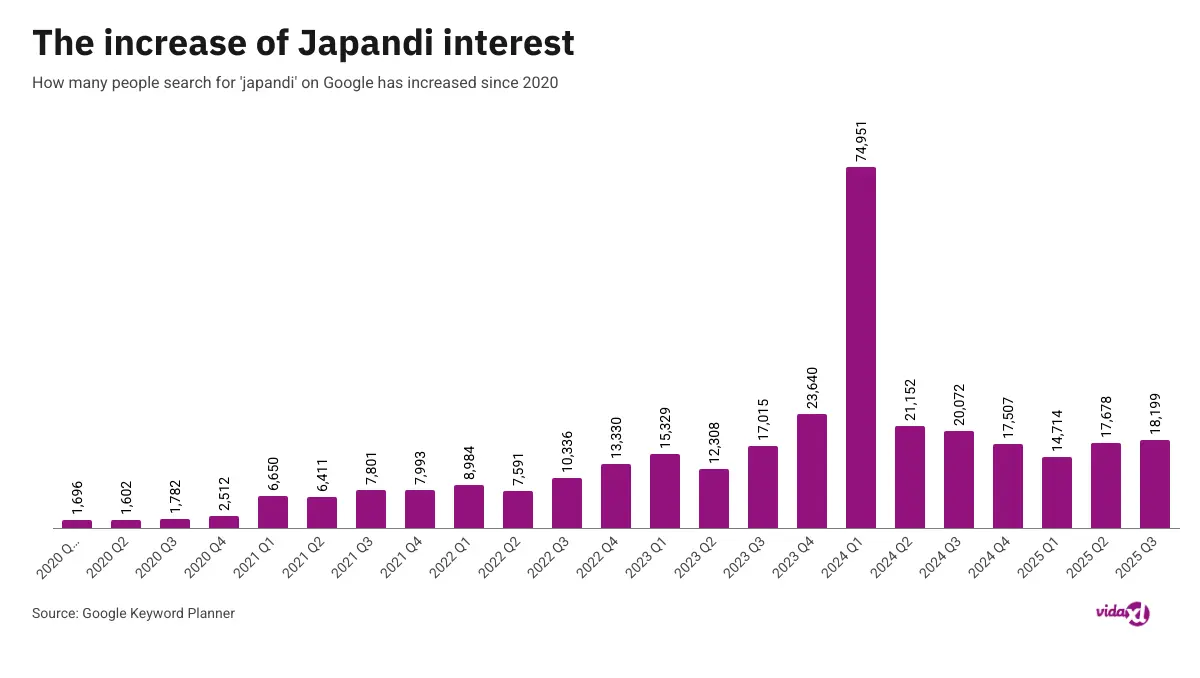
The growing global fascination with Japandi is reflected in Google searches. With Japandi's rising popularity, it continues to shape how people design and experience their homes. Especially within the last five years, Japandi has gained significant traction. Going from a niche aesthetic to a global design movement:
- Interest in the Japandi style saw a dramatic increase in 2023, with the highest search volume on Google reaching 17,003 in February 2023.
- From 2020 through 2025, there has been a steady upward trend in search interest, with peaks in early 2023 and 2025.
- While there have been some fluctuations in search interest, the overall trend has remained positive, indicating that the Japandi style continues to catch people's attention.
- This suggests that Japandi interest is likely to continue rising, with high search volumes expected into 2026.
Alongside Google, The Fall 2024 Trend Report by Pinterest also showed an expanding interest in Japanese culture overall, and searches for "Japanese living room design" on the inspirational platform had even increased by 135%. This seems to reflect a growing desire among users to incorporate elements of Japanese aesthetics into their homes. It suggests that people are not only drawn to the tranquil beauty of the Japandi style but are actively seeking inspiration and guidance on how to blend these principles with their own living spaces.
The interest in Japandi style even extends beyond Google searches and Pinterest pins. In the past 12 months, 784 TikTok posts in the United Kingdom have been marked with the hashtag "japandi" (TikTok Creative Center). This shows that people aren't only seeking inspiration – many have already incorporated the Japandi style into their homes and are eager to share their experiences and connect with others who share similar tastes.
As shown in the graph below, the interest in Japandi has even surpassed Scandinavian design in recent years. This shift highlights how people are increasingly drawn to the balance Japandi offers: the clean functional aspects of Scandinavian interiors blended with the serene simplicity of Japanese design.
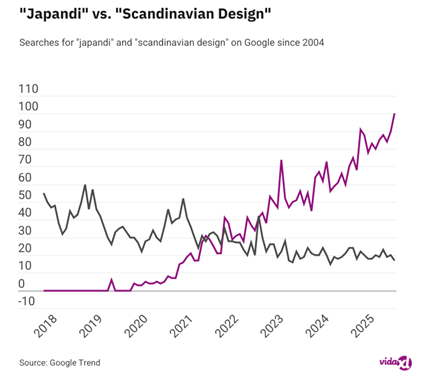
While Scandinavian design has long been celebrated for its practicality and light-filled warmth, Japandi brings another emotional dimension — calmness, mindfulness, and a sense of connection to nature.
East meets North for a calmer home and mind
Japandi represents the meeting point of two distinct yet complementary design philosophies from opposite sides of the world. The word Japandi blends "Japan" and "Scandi," uniting the elegance of Japanese "wabi-sabi" with the inviting warmth of Scandinavian "hygge".
From Japan, wabi-sabi brings an appreciation for imperfection and the passage of time. It celebrates natural elements and materials as well as handcrafted details. It often features organic textures, muted tones, and items that age gracefully.
Scandinavian hygge focuses on cosiness, warmth, light, and functionality through elements like soft textiles, glowing candles, and uncluttered layouts. Where wabi-sabi encourages calm through simplicity, hygge enhances it through comfort and connection.
Despite coming from opposite sides of the world, Japanese and Scandinavian design share a remarkably similar spirit when it comes to a calm, clutter-free home. Shanty Wijaya, interior designer and owner of AllPrace, says in an interview with Architectural Digest that "Japanese and Scandinavian have a lot in common in terms of design and aesthetic: They both put high value in simplicity; good quality, natural material; and craftsmanship."
This shared foundation is what makes their fusion, Japandi, feel so seamless and intuitive. Where Japanese interiors value harmony and balance, Scandinavian spaces celebrate comfort and clarity. Both prioritise simplicity, quality, and a deep connection to nature. Together, they form an aesthetic that is calm and purposeful.
How to bring Japandi into your own home
Do you dream of mixing Scandinavian style with traditional Japanese interior and bringing that clean, clutter-free feeling home? Here's how to do it:
- Start by decluttering and simplifying, keeping only what serves a purpose or brings joy. In Japandi interiors, space itself becomes a form of calm, allowing light, air, and texture to take centre stage.
- Choose natural materials to ground your home in authenticity. Wood, linen, stone, bamboo, and cotton create warmth and texture while connecting your space to nature. Let these materials tell their own stories over time.
- Invest in quality over quantity – Japandi values craftsmanship and durability over fast-changing trends.
- Finally, add greenery as a living element of calm. A single bonsai, a leafy plant, or a simple branch in a vase brings life and balance indoors.
Choose your Japandi aesthetic with vidaXL
With vidaXL, creating a Japandi-inspired home becomes both simple and accessible. Choose from a range of furniture and décor that perfectly capture the balance between Japanese minimalism and Scandinavian comfort.
"At vidaXL, we've seen a growing interest in our Japandi-style furniture, as customers want to embrace the unique aesthetic. With our selection of wooden furniture and décor, creating a Japandi-inspired home has never been easier or more accessible." – Berta, Head of Commercial Operations at vidaXL
Think oak tables, bamboo accents, and simple shelving that let the materials speak for themselves. Our selection features pieces designed with timeless simplicity, ensuring your home feels calm, uncluttered, and effortlessly elegant.
Pair these furnishings with neutral tones and organic elements to maintain that signature Japandi harmony. Soft beige, warm wood, and off-white shades create a tranquil foundation that you can personalise with handcrafted details or ceramic décor.
With vidaXL, it's easy to create a home that feels grounded, harmonious, and inspired by the beauty of both Japan and Scandinavia.